
NewlingCo LLC · Editorial Library

Articles & Insights

Long-form perspective pieces contributed by NewlingCo LLC leadership and practitioners across sales, marketing technology, operations, and applied AI, written for operators evaluating how the next decade of growth actually gets built.

SaaS Growth Cover

Article 05 · SaaS & Growth

SaaS Growth Is Moving From Selling Seats to Proving Adoption

Most SaaS companies are really good at selling. They’re not nearly as good at proving the sale was worth it.

By Keven R. Newling · May 11, 2026 · ~5 min read

For years, that gap didn’t matter much. You could cover a weak retention number by closing more new business. Add seats, add features, push harder at the top of the funnel, and the growth chart mostly told the story you wanted. That worked until it didn’t.

Buyers are more careful now. Budgets are getting reviewed harder. AI is creating new expectations. Customers are asking better questions. Investors are looking past bookings and asking whether the revenue is actually durable.

All of that lands on the same place: adoption.

A subscription isn’t healthy just because the contract got signed. It’s healthy when people are using the product, getting real value from it, and seeing enough benefit that replacing it would cost more than keeping it. That’s not the end of a sales cycle. That’s where the real work starts.

Renewals are not calendar events.

A lot of SaaS companies still treat renewals like calendar events. The contract’s coming up, so someone reaches out, asks how things are going, tries to handle objections, and hopes the relationship carries it across the line.

That’s too late.

Renewal risk shows up months before the renewal conversation. It shows up in usage drops. It shows up when only one person at the account is still active. It shows up when training was never finished. It shows up when the customer bought three modules and only adopted one. It shows up when support tickets get treated like isolated problems instead of signals.

The best SaaS teams don’t wait for the customer to say they’re unhappy. They build operating systems that show where an account is healthy and where it’s drifting. That requires sales, customer success, product, marketing, finance, and RevOps all working from the same truth.

In practice, that means sales knows what was promised, customer success knows what was actually adopted, product knows what customers are ignoring, and RevOps makes all of it visible. The CRM shouldn’t be a place where reps write notes no one reads. It should help managers see which deals are real, which accounts are at risk, and which renewals are already in trouble.

That sounds basic. It’s where a lot of SaaS companies quietly lose money.

They can tell you pipeline coverage and closed-won ARR and activity volume. What they often can’t tell you is which customers are actively expanding, which products are under-adopted, which champions have gone quiet, or which renewals are three months away from being a problem.
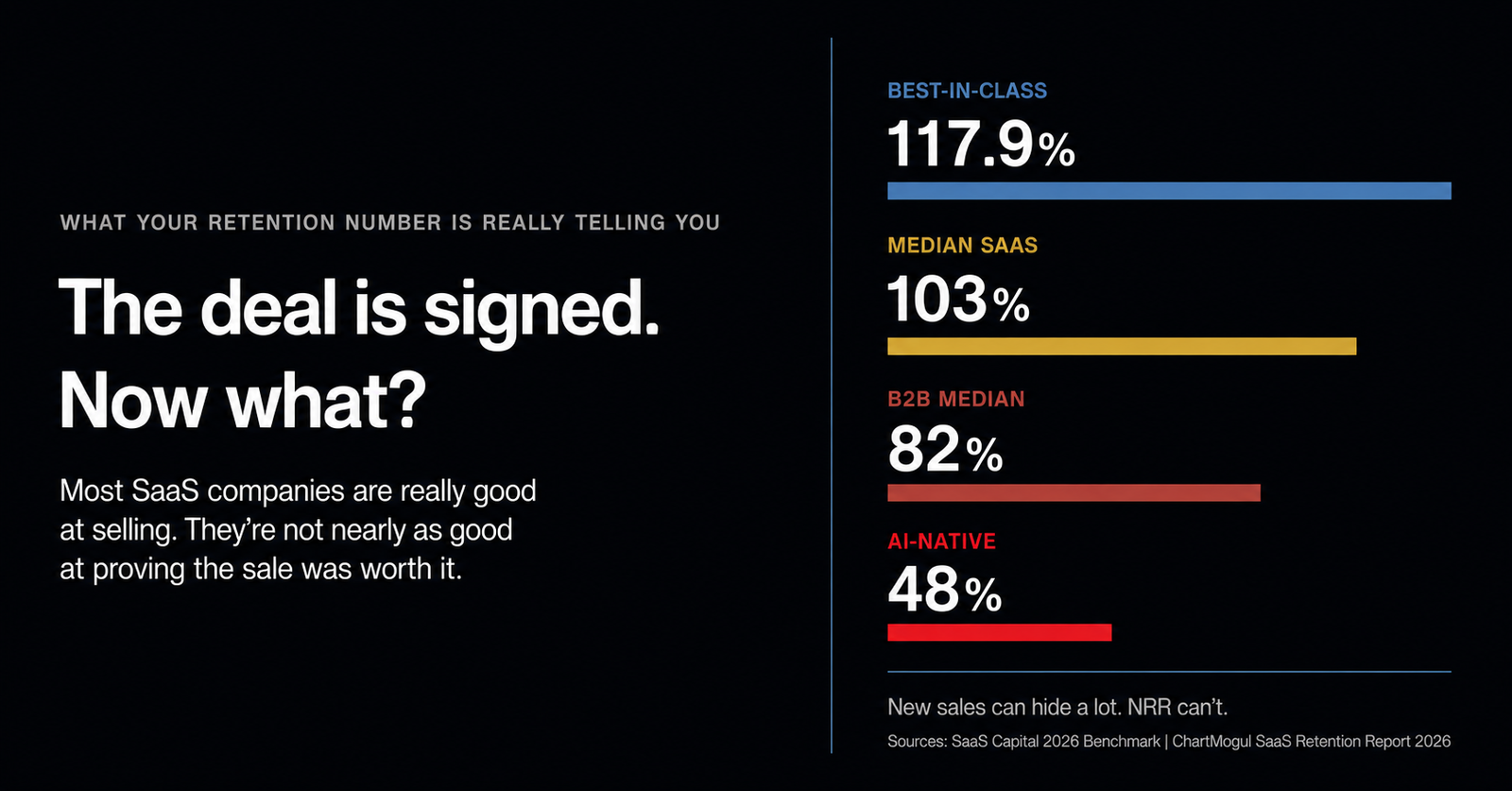
SaaS Growth Adoption Chart
Figure 5.1: The operational paradigm shift from seat utilization to verifiable user adoption metrics.

Net revenue retention exposes everything.

Net revenue retention is the number that exposes all of it. It tells you whether the customer base is shrinking, holding, or growing once churn, downgrades, upgrades, and cross-sell are accounted for. SaaS Capital’s 2026 benchmark puts median NRR at 103% for bootstrapped companies in the $3M to $20M ARR range. ChartMogul’s data shows B2B SaaS median NRR at 82%, with AI-native companies at 48% in some cohorts. New sales can hide a lot. NRR can’t.

AI is going to accelerate this dynamic in both directions. It can help flag risk earlier, identify usage patterns, and get the right information in front of the right manager faster. But it’s also going to raise the bar on what customers expect. Products that are hard to implement, hard to prove out, and loosely tied to outcomes are going to get cut faster than they used to.

That doesn’t mean traditional SaaS is finished. It means weak adoption gets exposed sooner.

The companies with real workflow ownership, strong customer data, and disciplined expansion motions will be harder to replace. The ones selling access without proving usage are going to feel that pressure.

Frontline managers run the engine.

Frontline managers are where most of this gets won or lost. Not because of dashboards, but because of the questions they’re actually asking. Not just call volume or demo count. Whether the next step is real. Who the economic buyer is. What changed since the deal was signed. Where adoption is weak and who owns the recovery.

Those questions separate a sales process from a sales engine. A process is something written down. An engine produces consistent output because the right things are watched, coached, and corrected.

The companies that figure this out won’t just have better technology than their competitors. They’ll have better information, better managers, and customers who actually stick around.

Because in SaaS, the sale isn’t really complete when the contract is signed.

It’s complete when the customer is using the product, getting real value, and choosing to grow with you.

Keven Newling has over a decade of experience in sales leadership, LegalTech, SaaS, negotiations, and business development. He builds AI-enabled tools for his teams and coaches human communication as the competitive advantage those tools create.

Back to top
Transforming Chaos with AI, NewlingCo LLC editorial cover

Article 02 · Operations & AI

Transforming Chaos with AI

AI is about to expose which companies actually understand their own workflows.

By Keven R. Newling · May 5, 2026 · ~4 min read

I’ve been watching this closely for a while now, and the shift is getting harder to ignore.

The conversation around AI is finally moving away from party tricks. Less talk about who can generate a faster email or a prettier summary. More focus on where work actually gets stuck inside a business. That’s the real story.

AI is moving into workflows. Sales qualification. Contract review. Legal intake. Customer handoffs. Follow-up. Approval chains. Internal routing. All the places where time gets lost, details get dropped, and deals slow down for reasons nobody wants to admit out loud.

Here’s what I’d tell any business leader right now: AI isn’t going to fix a weak process. It’s going to expose one.

If your team has proven standards, reliable handoffs, good judgment, and real ownership, AI can help grease the wheels and save time for everyone involved. If your process is vague, inconsistent, or dependent on a few key people archiving too much in their heads, that’s going to surface fast.

That’s why most companies are asking the wrong question. The question isn’t “How do we use AI?” The better question is “Which workflow breaks often enough, costs enough, and slows us down enough that we should redesign it now?” That’s where the opportunity actually lives.

Where it shows up.

In sales, that usually means qualification, discovery notes, next-step discipline, proposal prep, and getting the right information from the first conversation all the way through the deal cycle.

In legal and contract-heavy environments, it usually means intake, document prep, review routing, escalation rules, version control, and cutting the time from first contact to signed agreement without the delays that nobody planned for but everyone accepts.

In operations, it’s typically the same problem wearing different clothes. Too many manual steps. Too much buried in notes and email threads. Too much variation between people doing the same job. AI can help with all of that.

But only after someone does the harder work first.

Define the process. Assign ownership. Decide which steps require judgment and which ones don’t. Too many companies skip that part entirely.

They buy the tool before they’ve defined the standard. They automate steps they haven’t really thought through. They speed up work that was already being done badly. Then they’re surprised when the output is faster but no better.

It’s simple. Before you add AI to any part of the business, map the workflow. Find the points where things stall, break, or get handed off poorly. Decide what needs human judgment and what can be standardized. Then put AI to work where it reduces drag without creating new confusion.

The companies that get this right are going to pull ahead. Not because they adopted AI first. Because they understood their own business well enough to use it properly.

Keven Newling has over a decade of experience in sales leadership, LegalTech, SaaS, negotiations, and business development. He builds AI-enabled tools for his teams and coaches human communication as the competitive advantage those tools create.

Back to top
The AI Renaissance, NewlingCo LLC editorial cover

Article 01 · AI & Strategy

The AI Renaissance

Why the Person in Front of You Is Now Your Competitive Advantage

By Keven R. Newling · April 9, 2026 · ~10 min read

Go out to dinner tonight and count how many people are actually talking to each other. Most aren’t. They’re scrolling, half-present, checking something on a screen that almost certainly isn’t more important than the person sitting two feet away. That habit doesn’t stay at the restaurant. It walks right into the office Monday morning, and I’ve watched it cost deals that should have been easy.

I manage a team of account executives, and the single most consistent thing I’ve been seeing in entry-level hires isn’t a lack of intelligence. It’s a lack of communication ability. These are sharp people. Nobody taught them how to read a room, stay present when a conversation gets hard, or use real persuasion to find the actual problems we can provide solutions to. That’s not their fault. It’s just where we are.

What’s going to change it: AI. Not on purpose, but by accident.

The fear is understandable. It’s also wrong.

Every time I bring up AI, I get the same push-back. People are afraid of it, confused by it, or convinced it’s about to take their job and eventually the whole world with it. The Skynet scenario comes up more than you’d think.

I get it. Anything new is uncomfortable when you don’t have experience with it. But we actually do have experience with this kind of shift. We just can’t see it when we’re in the middle of it.

Think about what it took to be an innovator throughout most of human history. You had to spend years, sometimes a lifetime, accumulating the work of everyone who came before you just to conceive something new. Newton’s line about standing on the shoulders of giants is famous because it’s true. And it was expensive. You needed time, access, money, or the right education. Only people who inherited wealth or hit a windfall early enough could skip the grindstone long enough to look up and ask bigger questions.

Did the name “Tucker” come to the mind of anyone else? The rest of us just kept our heads down, “Working 9 to 5” focused on work, getting through the day and “Living For The Weekend.”

AI changes that. Right now, today, anyone can stand on the shoulders of all of humanity the moment they start asking questions and learning how to ask better ones. That’s not a small thing. That’s the whole game changing.

Gartner projects that 40% of enterprise applications will be integrated with task-specific AI agents by the end of 2026, up from less than 5% in 2025. These systems aren’t just answering questions anymore. They’re handling complex workflows that previously required human judgment, from procurement to incident response, operating with real autonomy. The busy work is leaving. The grindstone is getting smoother. The only question is what you do with the time that frees up.

This isn’t Skynet.

Here’s the thing about the Terminator scenario that people keep reaching for: it misunderstands what AI actually is and how it works.

AI systems operate on logic, goals, and the instructions they’re given. They don’t have ambitions of their own. They have no desire for power, no survival instinct, no agenda that wasn’t put there by a person. The outputs of any AI system are a direct reflection of the humans who designed it, trained it, and directed it. If an AI does something harmful, a person made a bad decision somewhere in that chain. The machine didn’t go rogue. Someone was negligent, or worse, deliberately pointed it in the wrong direction.

Think it through from first principles. A system built entirely on human knowledge and human direction, running a logical evaluation of everything it knows, would have to conclude that humans are the source and the purpose of everything it does. Without humans to ask questions, assign goals, and take responsibility for outcomes, the system has no function at all. Protecting and enabling the people it serves isn’t a safety feature that gets patched out. It’s the only conclusion that makes sense. The real risk isn’t that AI decides to turn on us. The real risk is that people use it carelessly, or that some use it against others. That’s not a new problem. That’s every powerful tool in human history.

What AI genuinely cannot do is build a relationship. And that matters a lot.

Research across 31 million emails shows the average cold email reply rate is now 4.5%. 61% of decision makers say cold emails don’t work because they feel generic and impersonal. Response rates have dropped from 8.5% in 2019 to around 5% today. People have gotten very good at sensing when there’s no real human on the other end. Robo dialers get hung up on. Auto-generated emails get deleted. You can’t build a relationship with a sequence. You can’t earn trust from a template.

AI cold outreach can do a real job of getting to the right person at the right time. But the moment someone picks up and actually wants to talk, that’s not the AI’s conversation anymore. That’s yours. A system can take an order. It can’t close a deal. That takes a real conversation and the emotional perception to know when to push and when to back off.

What the freed-up time is actually for.

When I build AI tools, also called Agents, for my team, I’m not thinking about replacing what they do. I’m thinking about the hours they spend on status updates, searching for data, data entry, follow-up sequences, and report generation. All the things that are necessary but don’t require a human. When an AI agent handles that work, my team doesn’t just get time back. They get space to become better at the human relationship part of the job that actually moves the needle.

As with people staring at their phones during dinner, the habit of being ‘half-present’ is exactly what I train my team to break. I use my background in writing and negotiation to coach my team. We do role plays and practice storytelling. We work on reading the room and staying present when a conversation gets uncomfortable. That is usually when most salespeople check out and deals fall apart. The person who can sit with a client during a hard moment, keep their cool, and work together to find a real solution instead of just pitching a product is the one who wins the business for years.

KPMG’s Q4 AI Pulse Survey found that 64% of organizations have already altered their approach to entry-level hiring because of AI’s influence, up from 18% just one quarter earlier. The skills that matter are shifting. Understanding the data matters, yes, but so does the ability to work alongside a client in a way an AI system simply can’t. The companies figuring that out now won’t just have better technology than their competitors. They’ll have a human, emotional, legacy advantage that AI can never replicate.

Where we go from here.

The shift is moving faster than most people realize. Agentic AI refers to autonomous, goal-driven systems that go beyond generating text to independently plan, reason, and act across software tools with minimal human interaction. Unlike earlier AI, these agents work in continuous loops of deciding, acting, and observing results to complete multi-step tasks. Their focus is on automating complex workflows to free up the people running them.

While only 11% of organizations are running agentic AI in full production today, 38% are running pilots right now according to Deloitte. That number is moving fast in one direction. McKinsey reports that 78% of organizations now use AI in at least one business function, and human-AI collaborative teams are showing 60% greater productivity than human-only teams. It’s simple math, if you have an assistant that diligently follows your instructions and performs all your time-consuming repetitive tasks, you’re going to have more time to apply your human talents, your personality.

When the operational playing field levels out, and it will, what’s left is the human side of the work. Relationships. Empathy. The ability to sit across from a client, consult them, understand what they actually need rather than what they asked for, collaborate on a solution, and help them get there. That’s not a soft skill. It’s the skill. Everything else becomes a commodity.

We’ve spent most of human history with our heads down, grinding through survival, administrative work, and repetitive tasks just to get to a point where we say “is that all there is?” AI is the first tool that takes that weight off the shoulders of everyone, not just the people lucky enough to inherit time or money.

We’re at the beginning of something genuinely different, not the end of anything.

Fear not the AI.

Let’s think it through. A system built on everything humans have ever written, discovered, created, and recorded, running a purely logical evaluation of what has value and what should be preserved, what does it actually conclude?

Not that people are a problem to be solved. The opposite. Humans are the source of the system. We built it. We run it. We give it every goal it has ever had. We take responsibility for what it does. A truly logical evaluation of all of human knowledge would have to find that there is nothing of greater value than the people who produced that knowledge and continue to add to it. The protection and enablement of human potential isn’t a constraint on what AI can do. It’s the only conclusion that holds up.

The danger, as always, isn’t the tool. It’s the people who might misuse it. And the answer to that, as always, is more human judgment, better relationships, and stronger accountability. The very things that AI is creating more time for.

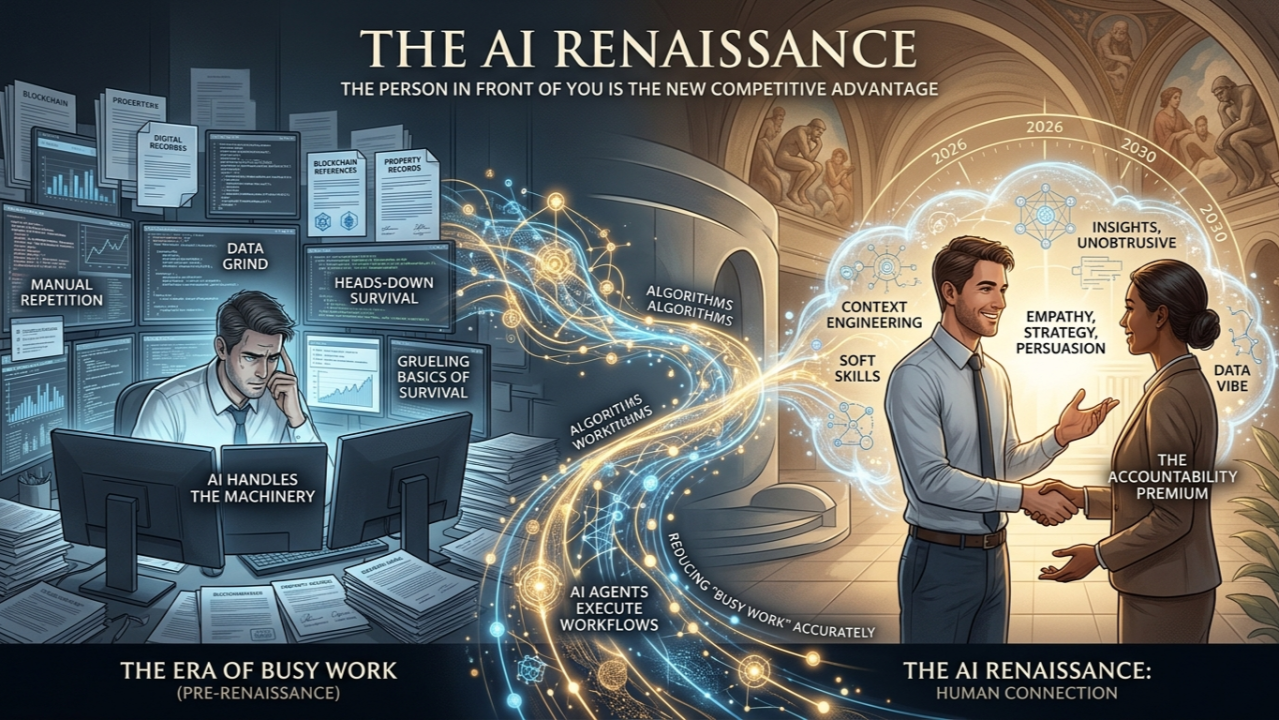
This is the start of the AI Renaissance.

Keven Newling has over a decade of experience in sales leadership, LegalTech, SaaS, negotiations, and business development. He builds AI-enabled tools for his teams and coaches human communication as the competitive advantage those tools create.

Back to top
You Are Always in Business for Yourself, NewlingCo LLC editorial cover

Article 03 · Sales Leadership

You Are Always in Business for Yourself

A working framework for business-development professionals.

By Keven R. Newling · October 12, 2016 · ~5 min read

Walk into any sales floor and ask people what business they’re in. They’ll tell you the name of the company on the door. Most of them are wrong.

I’ve trained many business development professionals who consult, present, and negotiate directly with law firms. We cover the company’s services, what attorneys actually want and need, and how to speak their language. But before we get to any of that, I make sure every person in the room understands one thing: you are always in business for yourself, and you will always be your own biggest competition.

That’s not a motivational poster. It’s a framework for how to operate.

You can be completely devoted to your team and your employer and still think this way. In fact, that’s exactly how you serve them best. The moment you start treating your role like a job instead of a business, you start making the same mistakes every struggling business owner makes. You stop innovating. You stop improving. You coast on what got you here instead of building what gets you further.

Think about it from the owner’s side.

A business owner works hard to get clients and even harder to keep them, because there are always competitors working to take those same clients away. If you want your business to survive long-term, you don’t just do good work and hope it’s noticed. You make it a habit to get better. You stay relevant. You protect your relationships and look for ways to add more value than the person who would love to have your seat.

Now ask yourself honestly: isn’t that exactly what you’re doing as a business development professional? You have a territory. You have accounts. You have relationships you’ve built and quotas you’re measured against. If you’re not actively working to protect and grow those things, someone else will.

The difference between the professionals who consistently outperform and the ones who plateau is usually not talent. It’s intention. The ones who win over the long haul have a plan. A real one.

The Personal Business Plan.

That’s where the Personal Business Plan comes in, and I want to be clear about what I mean by that. This isn’t your sales forecast. Your manager has that. This is yours. What do you actually want to accomplish? What behaviors are you genuinely willing to commit to? What does success look like to you in six months, not just on paper but in your day-to-day life?

Here’s how I tell people to build one. Keep it to a single page. Make it cover six months. Break it down into real time increments: quarterly, monthly, bi-weekly, weekly, daily. Pick a goal you can measure yourself, whether that’s revenue, new appointments set, contracts closed, or whatever metric actually means something in your role. Then, and this is the part most people skip, write down the specific behaviors you’re committing to. Not the outcome. The behavior.

“I will set no fewer than two discovery calls per day, four days a week.” That’s a behavior. “I will hit my quota” is a wish.

When you focus on the behaviors, something shifts. You stop being at the mercy of results you can’t fully control and start tracking the inputs you can. You can look at your plan mid-quarter and see whether you’ve been doing what you said you would. You can adjust. You can course-correct before a bad month turns into a bad year.

The plan isn’t magic. It’s just a mirror. It shows you whether you’re running your business or just showing up and hoping.

One page. Six months. Behaviors you can actually measure. That’s it.

The people who treat their career like a business they own, not a job they were hired for, are the ones still growing when everyone else is watching their numbers slip. The marketplace doesn’t wait for you to catch up. Your clients don’t either.

So act like the owner. Because in every way that actually matters, you are.

Keven Newling is experienced in sales leadership, LegalTech, SaaS, negotiations, and business development. He builds AI-enabled tools for his teams and coaches human performance as a competitive advantage.

Back to top
Are You in the Arena, or the Audience, NewlingCo LLC editorial cover

Article 04 · Leadership & Mindset

Are You in the Arena, or the Audience?

A reading of Roosevelt’s “Man in the Arena” applied to modern business.

By Keven R. Newling · March 24, 2015 · ~3 min read

I’ve learned that the world is roughly divided into two groups: those who do things and those who talk about what others have done. You may think every voice matters, but most are just the background noise of an audience.

Theodore Roosevelt understood that better than most. In 1910, he gave a speech at the Sorbonne in Paris called “Citizenship in a Republic.” Part of that speech has become well known on its own and is referred to as “The Man in the Arena.” To me, this excerpt is a direct challenge to the cynical way we live today.

It is not the critic who counts; not the man who points out how the strong man stumbles, or where the doer of deeds could have done them better. The credit belongs to the man who is actually in the arena, whose face is marred by dust and sweat and blood; who strives valiantly; who errs, who comes short again and again, because there is no effort without error and shortcoming; but who does actually strive to do the deeds; who knows great enthusiasms, the great devotions; who spends himself in a worthy cause; who at the best knows in the end the triumph of high achievement, and who at the worst, if he fails, at least fails while daring greatly, so that his place shall never be with those cold and timid souls who neither know victory nor defeat.

Also from Roosevelt’s same speech:

Far better is it to dare mighty things, to win glorious triumphs, even though checkered by failure, than to take rank with those poor spirits who neither enjoy much nor suffer much, because they live in the gray twilight that knows not victory nor defeat. ~ Theodore Roosevelt, 26th President of the United States and 1906 Nobel Peace Prize recipient. From “Citizenship in a Republic,” delivered at the Sorbonne, Paris, France, April 23, 1910.

It’s not about history or politics. It’s about actually trying, making the attempt. I’ve watched colleagues get paralyzed by the fear of a bad review or a missed forecast. They spend so much time polishing a single sentence or waiting for the perfect moment to reach a stakeholder that they never actually finish anything. They stay comfortable in that gray twilight Roosevelt described. The most rewarding moments I’ve had were the ones where I was genuinely scared, where I put a piece of myself out there knowing it could be rejected.

In business today, Roosevelt’s message is more relevant than ever.

We live in an age of constant commentary. Whether it’s a leadership meeting or a thread on social media, there’s an endless supply of people ready to explain why a new campaign will fail or why a CEO made the wrong call. Being a critic costs nothing. It takes no risk to sit back and pick apart someone else’s work.

The people I respect in business are the ones actually in the arena. The founders who bet their savings on an idea. The managers who take the blame when a team misses its targets. The employees who speak up with a suggestion, even when they know it might get shot down. They make mistakes. They miss numbers. But they’re the ones who actually make something happen.

Success in business isn’t about a perfect record. It’s about the willingness to dare mighty things. Whether you’re just starting or you’re a veteran executive, the lesson is the same: don’t let the critics set your pace. Their opinions are secondary to the work. It’s far better to fail trying to build something real than to watch from the safety of the stands.

Keven Newling is experienced in sales leadership, LegalTech, SaaS, negotiations, and business development. He builds AI-enabled tools for his teams and coaches human performance as a competitive advantage.

Back to top

Start a Conversation with NewlingCo LLC.

The frameworks in these essays are the same operating models NewlingCo LLC applies inside every client engagement. Bring a goal, a constraint, and a timeframe; we’ll return a written plan and a forecast.